
AI News Brief: May 1, 2026 - Agents, Search, Codex, and Enterprise Control
The biggest AI story on May 1, 2026 is not a single model launch. It is the shift from chat interfaces into governed, agentic business systems.
The companies shaping the market are now talking about agents that can use tools, operate in sandboxes, remember context, run long tasks, plug into business apps, and be governed by IT. That is the practical backdrop for Apex Blue's focus on AI agent installation and website-first agent rollouts.
At a glance
| Signal | What changed | Operator takeaway |
|---|---|---|
| OpenAI Codex | OpenAI said Codex now reaches more than 4 million weekly developers and is expanding across the software lifecycle. | Agents are becoming execution partners, not just code assistants. |
| OpenAI Agents SDK | OpenAI added sandbox execution, memory, filesystem tools, and safer long-horizon execution patterns to the Agents SDK. | "Agent installation" needs infrastructure thinking: workspace, permissions, sources, and state. |
| Google Cloud Next | Google framed Cloud Next '26 around the agentic enterprise, Gemini Enterprise Agent Platform, and new agent infrastructure. | Large platforms are packaging agents for non-ML teams and business users. |
| Google Search | Google upgraded AI Mode in Chrome so AI search can sit beside the web page while users compare and ask follow-ups. | Helpful, crawlable, text-rich pages still matter because AI search explores and cites supporting pages. |
| Microsoft | Microsoft announced Agent 365 general availability for May 1 and positioned it as a control plane for AI agents. | Governance is becoming a buying requirement, not an afterthought. |
| Meta | Meta introduced Muse Spark to power a smarter Meta AI with multimodal reasoning and parallel subagents. | Assistants are moving closer to social context, creators, and personal recommendations. |
| Anthropic | Anthropic's economic work keeps showing that experienced AI users collaborate more deeply and bring higher-value work to AI. | Adoption quality may matter as much as tool access. |
1. Codex is turning into an agent command center
OpenAI's April updates around Codex are a clear market signal. On April 16, OpenAI announced a major Codex update that lets the app operate across more of a user's workflow, including computer use, app integrations, image generation, memory, automations, multiple terminals, GitHub review workflows, and an in-app browser.
On April 21, OpenAI said Codex had grown from more than 3 million weekly developers in early April to more than 4 million two weeks later, and announced Codex Labs plus GSI partnerships to bring Codex into more enterprise engineering organizations.
The Apex Blue read: coding agents are becoming the proving ground for broader business agents. The pattern is not limited to software teams. The same installation questions apply to sales, support, operations, and marketing:
- What is the agent allowed to do?
- What sources can it use?
- Where does it hand off?
- How does a person review the work?
- What happens when the task runs longer than one prompt?
2. The Agents SDK news makes installation a real discipline
OpenAI's April 15 Agents SDK update is important because it focuses on the boring pieces that make agents usable: file access, sandbox execution, memory, code execution, tool use, and durable long-running work.
That matters for business owners because the agent category is no longer only about prompts. A useful agent needs a controlled environment, clean inputs, safe tool access, and a reliable handoff path.
This is why Apex Blue keeps using the word installation. A business does not only need "an AI agent." It needs the agent installed into the real workflow with boundaries, training, and support.
3. Google is making the agentic enterprise mainstream
At Google Cloud Next '26, Google said agentic technology is changing how organizations work and pointed to the Gemini Enterprise Agent Platform, new TPUs, Agentic Data Cloud, Workspace Intelligence, and no-code or low-code ways to create agents.
Google's recap also emphasized that AI agents are becoming active partners that can do work safely and autonomously, with Agent Studio and Agent Designer aimed at both developers and business users.
The important business takeaway is that agent building is being democratized. That creates opportunity, but it also creates risk. When every team can build an agent, companies need better intake, governance, and measurement.
4. AI Mode in Chrome makes source pages more important, not less
Google's April 16 update to AI Mode in Chrome lets users open a website side-by-side with AI Mode, ask follow-up questions, and add recent tabs, images, or PDFs as context.
Google Search Central's guidance for site owners is equally important: SEO fundamentals still apply to AI Overviews and AI Mode. Google specifically points to crawlability, internal links, page experience, textual content, media support when useful, and structured data that matches visible text.
That is the SEO lesson for businesses: do not publish thin trend commentary and hope AI search rewards it. Build content that defines the problem, answers the next question, supports comparison, and links into a useful cluster.
5. Microsoft is pushing agent governance into the buying conversation
Microsoft announced Agent 365 general availability for May 1, 2026, describing it as a control plane for observing, governing, managing, and securing agents across an organization. Microsoft also positioned its Microsoft 365 E7 Frontier Suite around Copilot, Agent 365, identity, security, and compliance.
For smaller and mid-sized businesses, the lesson is not "buy the enterprise suite." The lesson is that governance has moved to the center of the AI buying conversation.
Even a website-first AI agent needs:
- a human owner
- approved sources
- escalation rules
- data boundaries
- review cadence
- clear reporting
6. Meta is turning AI toward social context
Meta introduced Muse Spark on April 8 as the first model from Meta Superintelligence Labs. Meta said the model powers Meta AI in the app and website, supports complex reasoning and multimodal tasks, and can launch multiple subagents in parallel.
The bigger pattern is context. Meta is trying to make AI more useful by connecting it to recommendations and content across Instagram, Facebook, Threads, WhatsApp, Messenger, and AI glasses.
For marketers, this is a reminder that AI visibility will not live only in classic search. Social context, creator context, and platform-native recommendations will matter too.
7. Anthropic's economic research points to skill curves
Anthropic's Economic Index work keeps pointing toward a practical truth: experienced users tend to use AI in more collaborative, work-oriented, and complex ways.
That is good news for businesses willing to train. The companies that win will not be the ones that merely buy access to models. They will be the ones that develop better habits around prompts, review, source quality, workflow design, and governance.
What Apex Blue would do next
The business move is not to chase every model update. The move is to install the first useful agent where it can create measurable value.
For many companies, that means:
- Audit the website, call process, and lead intake.
- Choose one high-friction workflow.
- Clean the source content.
- Install a narrow agent with clear handoffs.
- Train the team.
- Review transcripts and outcomes weekly.
- Expand only after the first lane works.
Start with the long-form AI agent installation playbook, the service page for AI agent installation, or the diagnostic AI workflow audit.
Sources
- OpenAI: Codex for almost everything
- OpenAI: The next evolution of the Agents SDK
- OpenAI: Scaling Codex to enterprises worldwide
- Google Cloud Next 2026 news and updates
- Google: A new way to explore the web with AI Mode in Chrome
- Google Search Central: AI features and your website
- Microsoft: First Frontier Suite built on Intelligence + Trust
- Microsoft: The next phase of the Microsoft-OpenAI partnership
- Meta: Introducing Muse Spark
- Anthropic Economic Index: Learning curves
Put the next step to work for your business.
Tell Apex Blue what you want to improve in your marketing, website, or daily operations. We will help you identify a practical starting point.
Discuss your next stepShare this AI marketing article
Related articles and podcast resources
Continue learning with related posts and tune into the Navigating AI with Apex Blue podcast.
Weekly AI News & Updates: April 13, 2026
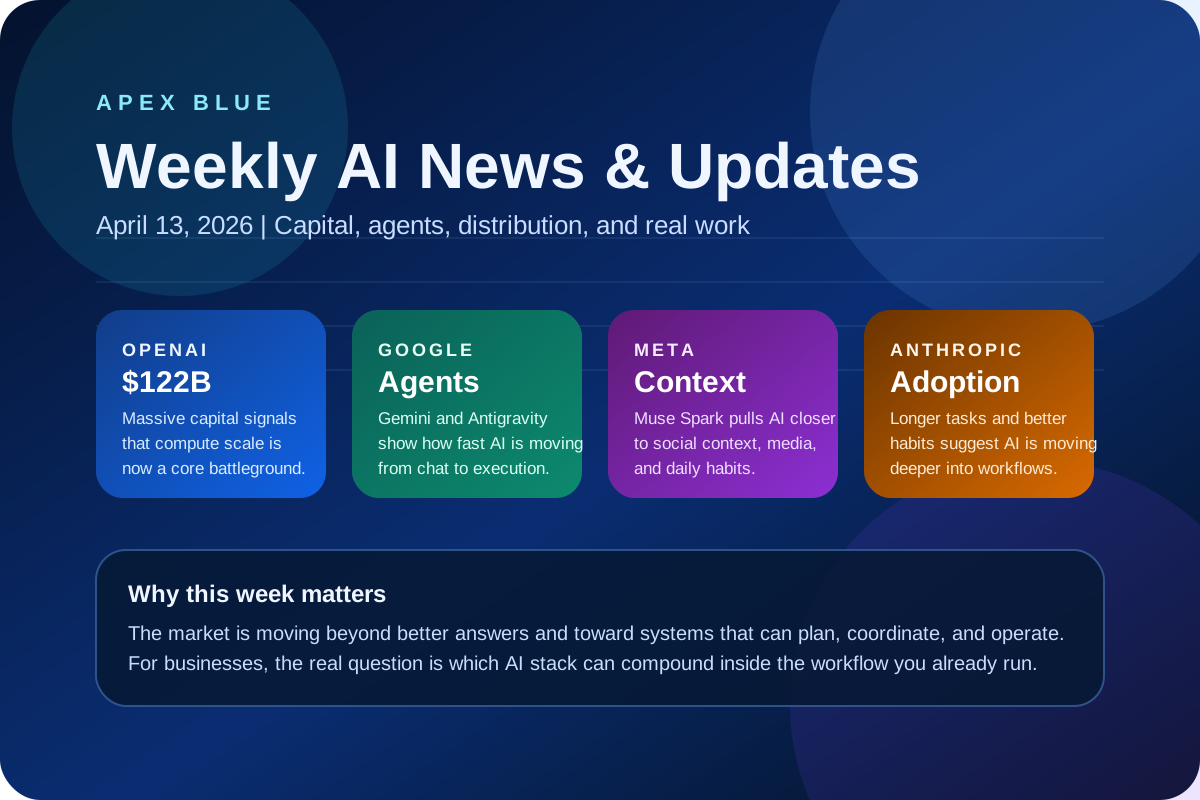
As of April 13, 2026, the biggest AI story is not just better chat. OpenAI is scaling infrastructure, Google is shipping agentic developer workflows, Meta is turning AI into a social context layer, and Anthropic is showing how usage is maturing inside real work.
Read article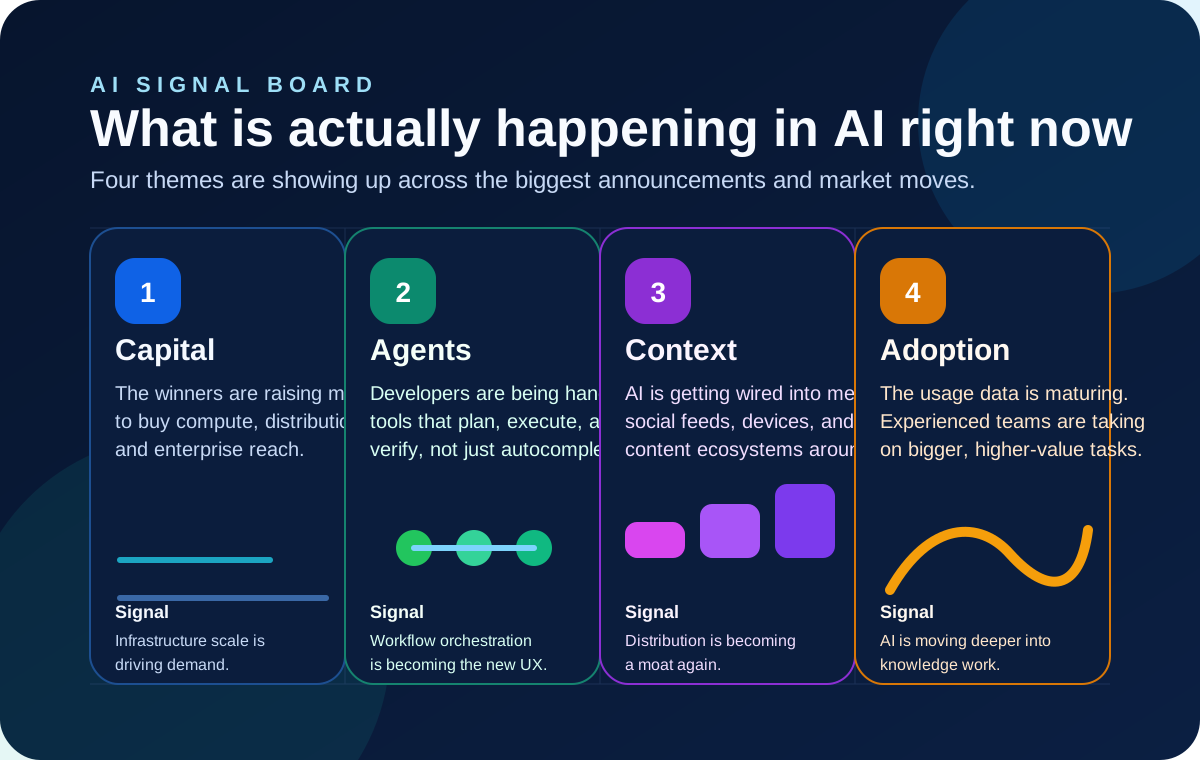
AI News Brief: May 11, 2026 - Bing AI Performance Turns GEO Into a Measurable Practice
Bing Webmaster Tools now gives publishers AI citation visibility across supported Microsoft AI experiences. That moves generative engine optimization from theory toward measurable content operations.
Read articleAI News Brief: May 11, 2026 - Google AI Search Links Reward Original Source Depth
Google is adding more links, source previews, and exploration paths inside AI Mode and AI Overviews. For businesses, that makes original, crawlable, well-structured pages more valuable, not less.
Read article