
Weekly AI News & Updates: April 13, 2026
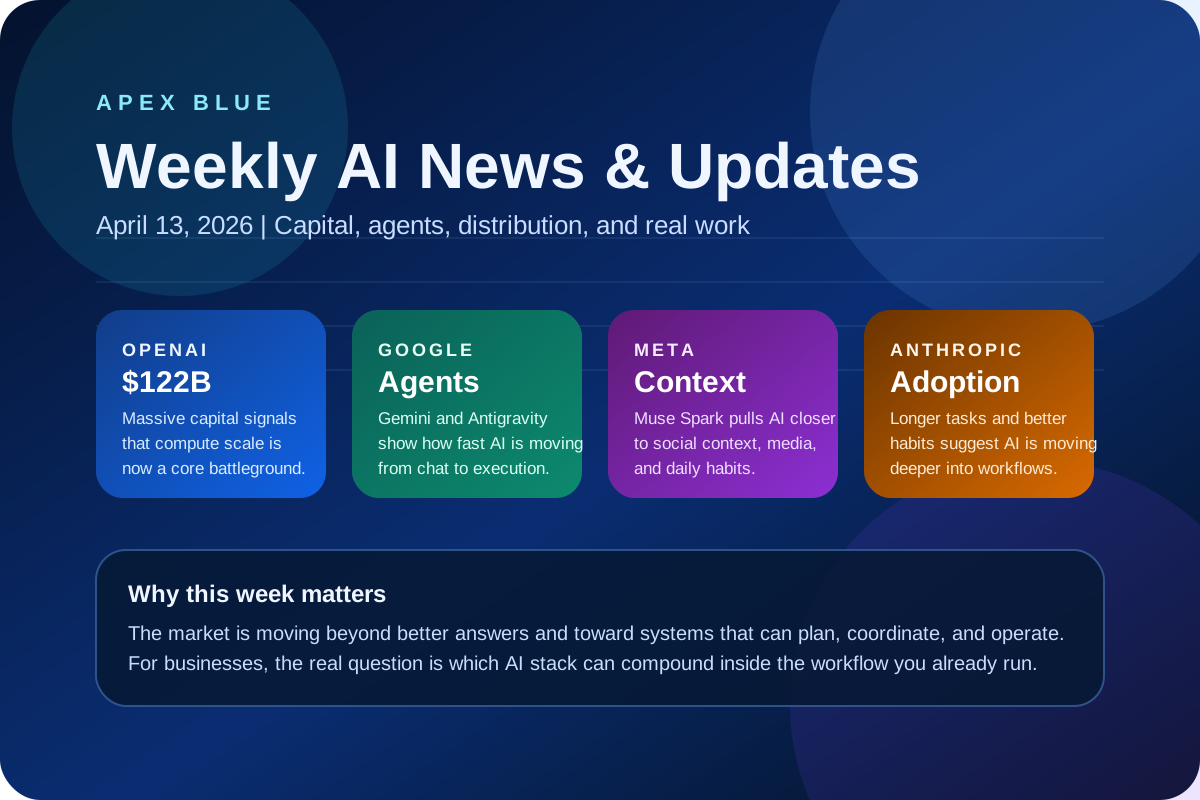
AI news is moving fast, but the clearest pattern as of April 13, 2026 is that the market is shifting away from simple chatbot novelty and toward full operating systems for work.
The most important updates right now are about capital, agentic execution, distribution, and real adoption inside knowledge work. That matters more than another headline about a benchmark jump.
This roundup combines the recent moves that feel most important for businesses trying to understand where the market is actually going.
At a glance
| Company | What changed | Why it matters now |
|---|---|---|
| OpenAI | On March 31, 2026, OpenAI said it closed a funding round with $122 billion in committed capital and released GPT-5.4 on March 5, 2026. | The race is now about scaling infrastructure and turning AI into durable business systems, not just shipping a smarter chat window. |
| Google introduced Gemini 3.1 Pro on February 19, 2026 and rolled out Gemini 3.1 Flash Live on March 26, 2026. | Google is pushing hard on agentic workflows, real-time voice experiences, and developer tooling. | |
| Meta | Meta launched Muse Spark on April 8, 2026 and expanded richer real-time content for Meta AI on March 13, 2026. | Meta is betting that AI becomes more useful when it is grounded in your social graph, content, and daily context. |
| Anthropic | Anthropic released its Economic Index report: Learning curves on March 24, 2026 and shipped Claude Opus 4.6 on February 5, 2026. | AI usage is getting more sophisticated, with experienced teams using it on higher-value, more collaborative work. |
1. OpenAI is widening the infrastructure gap
On March 31, 2026, OpenAI announced it closed a funding round with $122 billion in committed capital at an $852 billion post-money valuation.
That announcement matters because of how OpenAI framed the next phase. The company described compute, consumer adoption, enterprise deployment, developer usage, and products like Codex as parts of a reinforcing flywheel.
Then, on March 5, 2026, OpenAI introduced GPT-5.4, positioning it around professional work, coding, computer use, tool search, and a 1M token context window for longer-horizon workflows.
The source-backed fact here is simple: OpenAI is talking less like a model lab and more like infrastructure for business operations.
My inference from those announcements is that the real OpenAI story right now is not only model quality. It is the attempt to become the default execution layer for serious AI work across chat, developer tools, and connected business systems.
2. Google is making the agentic stack feel real
Google's recent releases feel less like isolated model updates and more like an effort to own the full path from model to workflow.
On February 19, 2026, Google announced Gemini 3.1 Pro, saying developers and enterprises could access it through AI Studio, Antigravity, Vertex AI, Gemini Enterprise, Gemini CLI, Android Studio, the Gemini app, and NotebookLM.
On March 26, 2026, Google announced Gemini 3.1 Flash Live, describing it as a faster, more natural audio model for real-time voice interactions. Google also said it was already live in more than 200 countries and territories through Search Live and Gemini Live.
Google's own March 2026 AI roundup ties those updates together and makes the bigger pattern clearer: Gemini is increasingly being packaged with the interfaces, coding tools, and developer surfaces needed to build actual agents.
The inference here is that Google does not just want to win on model quality. It wants to win on developer momentum by making agentic building feel accessible, fast, and deeply integrated into products teams already use.
3. Meta is pushing AI closer to personal context and live content
Meta made one of the more interesting moves of the past week.
On April 8, 2026, Meta announced Muse Spark as the first model from Meta Superintelligence Labs. According to Meta, Muse Spark now powers the Meta AI app and website and is rolling out to WhatsApp, Instagram, Facebook, Messenger, and AI glasses in the coming weeks.
Meta also said Muse Spark supports multimodal reasoning, can launch multiple subagents in parallel, and is designed to bring recommendations and content shared across Meta's platforms directly into AI answers.
That follows Meta's March 13, 2026 announcement about bringing more international news and content to Meta AI, including new publisher partnerships and more links out to trusted external articles.
The factual update is that Meta is making its AI assistant more connected to the content ecosystems inside and around its apps.
My read is that Meta's bet is very different from a pure benchmark race. It is trying to build an assistant that feels socially aware, personalized, and grounded in the relationships, creators, and public posts users already care about.
4. Anthropic is showing what maturing usage looks like
Anthropic's recent updates are useful because they say a lot about how AI use is changing in practice.
On March 24, 2026, Anthropic published its Economic Index report: Learning curves. The report said experienced users are more likely to get successful responses, collaborate with Claude more, use it for more work-related reasons, and bring more complex tasks to it.
Anthropic also highlighted two API workflows whose share at least doubled in the new sample: business sales and outreach automation, plus automated trading and market operations.
That report builds on Anthropic's February 5, 2026 release of Claude Opus 4.6, where the company emphasized better long-running agentic tasks, 1M token context in beta, context compaction, adaptive thinking, and agent teams in Claude Code.
The underlying signal is not just that Claude got better. It is that AI usage is moving deeper into real workflows where planning, iteration, long context, and collaboration matter more than one-shot prompting.
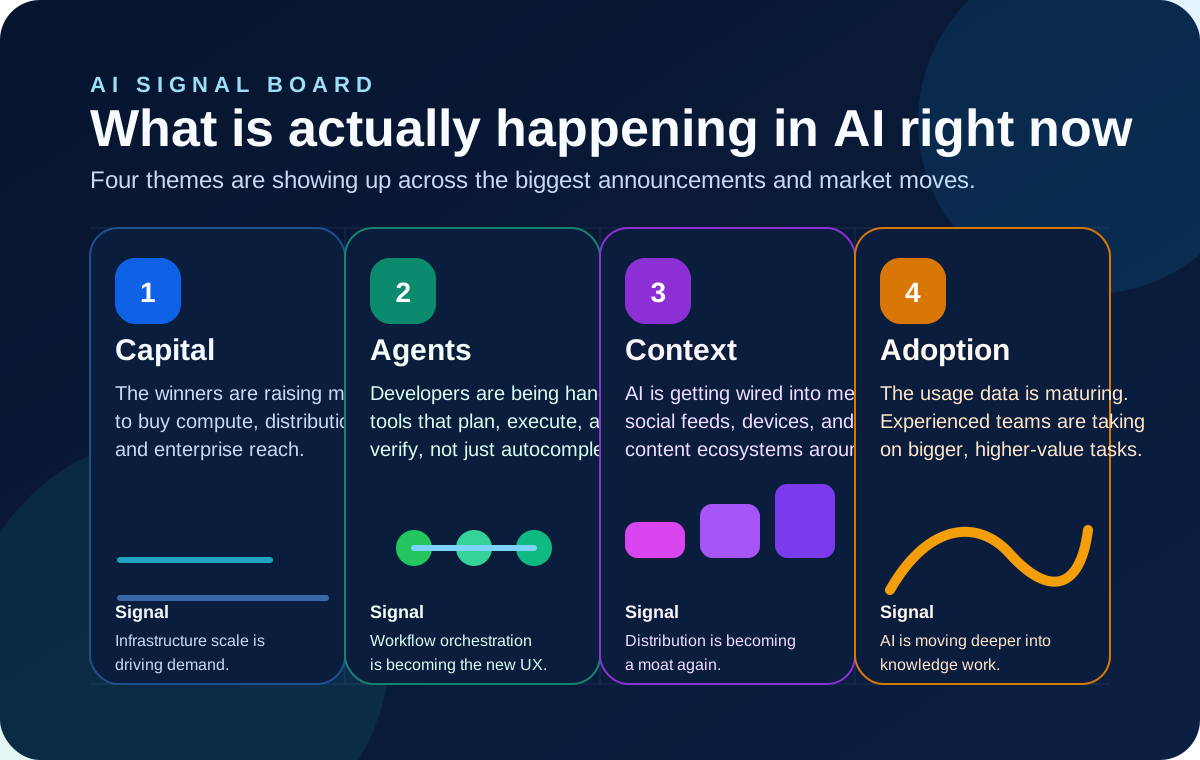
Original Apex Blue signal board summarizing the themes shaping AI right now: capital, agents, context, and adoption.
The bigger pattern behind this week's AI news
If you step back from the individual announcements, four signals stand out.
First, capital still matters a lot. OpenAI's funding round is a reminder that frontier AI leadership increasingly depends on sustained access to compute, infrastructure, and enterprise distribution.
Second, agents are becoming the product, not a side feature. Google and Anthropic are both emphasizing systems that can plan, coordinate, and execute across tools rather than just answer questions.
Third, distribution is becoming a moat again. Meta's push shows that AI becomes more defensible when it is tied to content networks, devices, communities, and habits people already have.
Fourth, learning curves are real. Anthropic's data suggests the teams that spend time building better AI habits are the ones getting more value out of the tools.
That last point may be the most important one for operators. The gap may not just be between companies that have access to AI and companies that do not. It may increasingly be between teams that know how to embed AI into real workflows and teams that still use it like a novelty tool.
What businesses should do with this
For founders, operators, and growth teams, this week's AI news points to a practical conclusion.
The market is rewarding systems that can do more than generate content. The real value is moving toward AI that can:
- work across documents, spreadsheets, websites, and business tools
- stay useful over longer multi-step tasks
- operate with context, memory, and guardrails
- plug into real workflows instead of sitting in a disconnected chat box
That is why the best next step for many companies is not asking, "Which model is smartest?"
It is asking:
- Which workflows are high-value enough to automate or accelerate first?
- Where do we need human review?
- Which tools already hold the data the AI needs?
- How do we build something that compounds instead of creating another disconnected subscription?
If you want help translating these market shifts into a practical rollout, start with an AI workflow audit or explore the Apex Blue AI C-Suite.
Trusted sources
- OpenAI raises $122 billion to accelerate the next phase of AI
- Introducing GPT-5.4
- Gemini 3.1 Pro: A smarter model for your most complex tasks
- Gemini 3.1 Flash Live: Making audio AI more natural and reliable
- Google AI announcements from March 2026
- Introducing Muse Spark: MSL's First Model, Purpose-Built to Prioritize People
- Bringing More International News and Content to Meta AI
- Anthropic Economic Index report: Learning curves
- Claude Opus 4.6
Put the next step to work for your business.
Tell Apex Blue what you want to improve in your marketing, website, or daily operations. We will help you identify a practical starting point.
Discuss your next stepShare this AI marketing article
Related articles and podcast resources
Continue learning with related posts and tune into the Navigating AI with Apex Blue podcast.
AI News Brief: May 1, 2026 - Agents, Search, Codex, and Enterprise Control
The May 1, 2026 AI news brief: agents are moving into governed business workflows, Codex is expanding beyond coding, Google is pushing AI Mode deeper into browsing, and Microsoft is packaging agent control for the enterprise.
Read article
AI News Brief: May 11, 2026 - Bing AI Performance Turns GEO Into a Measurable Practice
Bing Webmaster Tools now gives publishers AI citation visibility across supported Microsoft AI experiences. That moves generative engine optimization from theory toward measurable content operations.
Read articleAI News Brief: May 11, 2026 - Google AI Search Links Reward Original Source Depth
Google is adding more links, source previews, and exploration paths inside AI Mode and AI Overviews. For businesses, that makes original, crawlable, well-structured pages more valuable, not less.
Read article