
AI News Brief: May 11, 2026 - Google AI Search Links Reward Original Source Depth
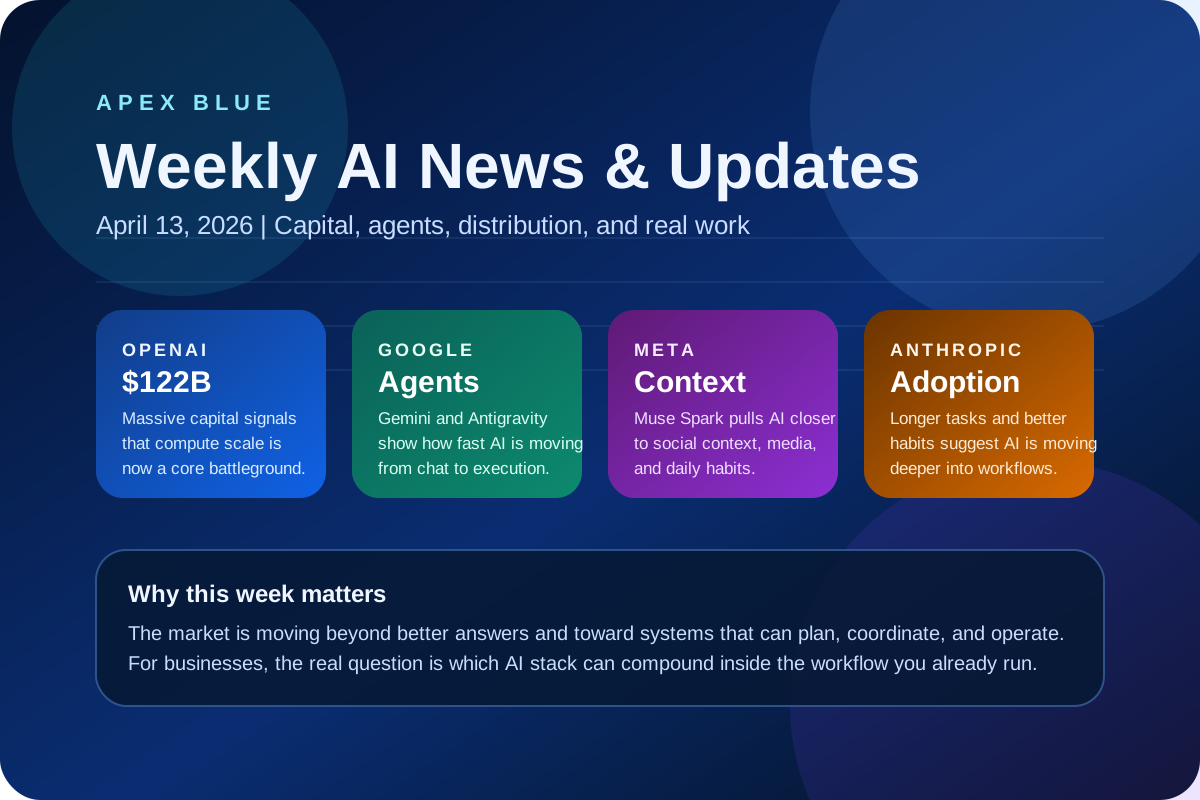
Google's May 6, 2026 Search update is a useful signal for any business trying to win visibility in AI answers. Google said it is rolling out new ways for AI Mode and AI Overviews to show relevant websites, original content, inline links, source previews, and deeper exploration paths.
That matters because the AI search conversation has often been framed as a traffic loss story. Some clicks will absolutely change. But Google's own product direction also shows that source selection, page clarity, and original expertise are still part of the system.
For Apex Blue clients, the practical lesson is simple: build pages that are good enough to support an answer, good enough to earn a link, and clear enough for a buyer to trust when they click through.
What changed
Google highlighted five search experience updates:
| Search surface | Business implication |
|---|---|
| Explore new angles | Long-form pages should cover subtopics, comparison points, edge cases, and next questions. |
| News subscription links | Recognized brands and trusted publishers can become easier to find inside AI responses. |
| Firsthand perspectives | Real experience, public proof, and named expertise matter more than generic summaries. |
| Inline links | A page can be valuable when it supports one precise claim, not only when it ranks as a classic blue link. |
| Link previews | Clear titles, metadata, and page positioning help people understand what they are about to open. |
This fits with Google's Search Central guidance for AI features: foundational SEO still applies. Crawlability, internal links, text content, page experience, helpful media, and structured data that matches visible text are still the baseline.
Query fan-out changes the content brief
Google has been clear that AI Mode and AI Overviews may use query fan-out, where the system runs multiple related searches across subtopics and data sources before forming a response.
That changes the page strategy. A page should not only target the obvious head term. It should also answer the follow-up questions a real buyer asks while comparing options.
For example, a page about AI agent installation should not stop at "what is an AI agent." It should also answer:
- what source material the agent needs
- how handoffs work
- when a website agent should start narrow
- how the business reviews transcripts
- what governance and escalation rules are required
- which outcomes should be measured
Those sections help both people and AI systems understand when the page is the right supporting source.
The Apex Blue action list
For service businesses, the most useful moves are not gimmicks. They are practical content and technical upgrades:
- Give each high-value service a canonical page with a clear title, useful FAQ, proof, process, and next step.
- Publish long-form support pages that define the category and connect related questions.
- Use visible headings that mirror real buyer language, not only internal brand language.
- Add structured data only when it matches visible content on the page.
- Keep source pages updated when offers, pricing logic, tools, or handoffs change.
- Make internal links obvious between service pages, news briefings, guides, and contact paths.
- Watch Search Console and Bing Webmaster Tools for changes in impressions, cited pages, and grounding queries.
The bigger idea: AI visibility is not separate from SEO. It is a stricter version of SEO where vague pages get less useful because machines have more choices.
Why this matters for buyer-ready phrases
High-value phrases like "AI search optimization services," "AI SEO agency," "generative engine optimization agency," and "AI automation consulting" are usually researched through comparison. Buyers want to know what the provider does, how the work is measured, and whether the company can turn strategy into execution.
That means the best page is not a keyword landing page. It is a decision page. It should help a buyer understand the problem, compare approaches, see tradeoffs, and know what to do next.
Apex Blue is treating AI search visibility as a connected system:
- service pages for commercial intent
- anchor guides for depth and entity coverage
- news briefings for recency and topical authority
- internal links that connect the whole cluster
- sitemap and robots signals that make the content easy to discover
What to do next
Start with the new AI search visibility services guide, then connect it to practical commercial pages like PPC SEO social strategy, AI agent development services, and AI automation consulting.
The right goal is not to "write for AI." The goal is to publish pages that are specific, current, useful, and easy to cite because they answer the question better than a generic summary can.
Sources
Put the next step to work for your business.
Tell Apex Blue what you want to improve in your marketing, website, or daily operations. We will help you identify a practical starting point.
Discuss your next stepShare this AI marketing article
Related articles and podcast resources
Continue learning with related posts and tune into the Navigating AI with Apex Blue podcast.
AI News Brief: May 11, 2026 - Bing AI Performance Turns GEO Into a Measurable Practice
Bing Webmaster Tools now gives publishers AI citation visibility across supported Microsoft AI experiences. That moves generative engine optimization from theory toward measurable content operations.
Read article
AI News Brief: May 11, 2026 - OpenAI SearchBot Makes Robots Strategy an AI Visibility Issue
OpenAI's crawler documentation separates ChatGPT search visibility from model training. For businesses, robots.txt is now part of AI discovery strategy, not only classic search hygiene.
Read articleAI News Brief: May 1, 2026 - Agents, Search, Codex, and Enterprise Control
The May 1, 2026 AI news brief: agents are moving into governed business workflows, Codex is expanding beyond coding, Google is pushing AI Mode deeper into browsing, and Microsoft is packaging agent control for the enterprise.
Read article