
AI News Brief: May 11, 2026 - Bing AI Performance Turns GEO Into a Measurable Practice
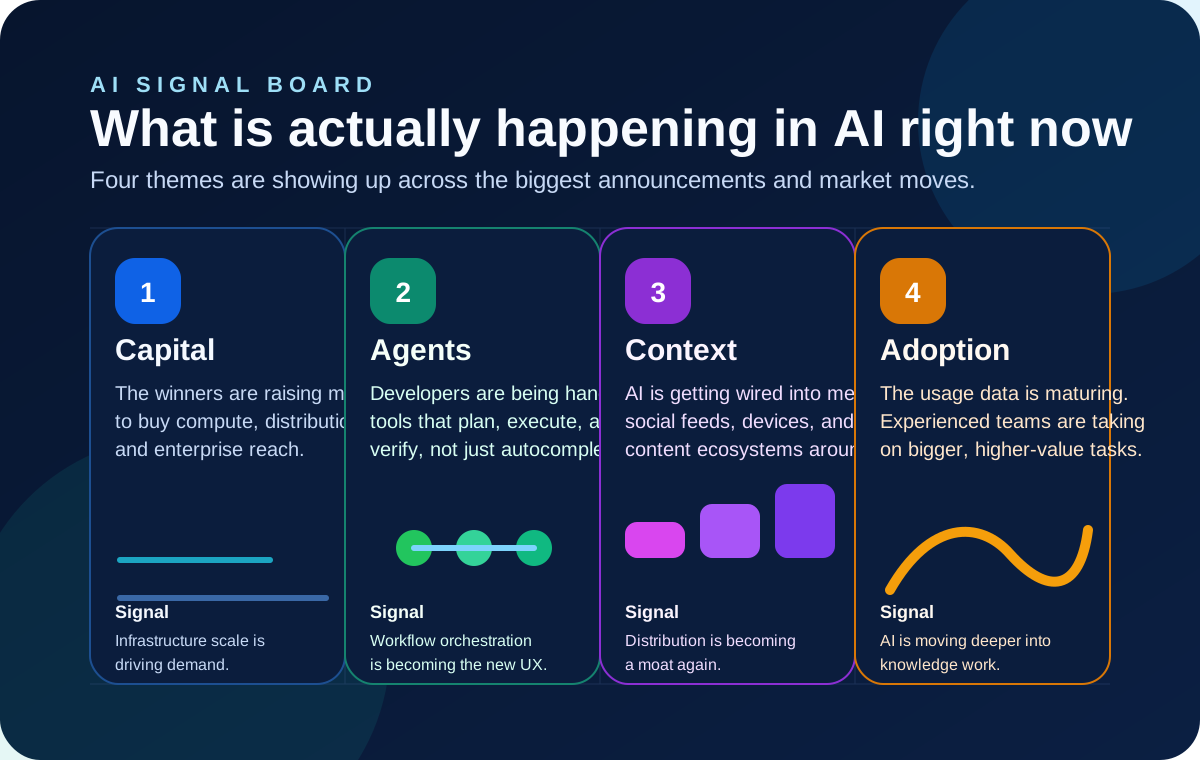
Bing Webmaster Tools' AI Performance report is one of the most important search measurement shifts for AI-era visibility.
The public preview gives verified site owners visibility into how their content appears across supported Microsoft AI experiences, including citation counts, page-level citation activity, grounding queries, and citation trends over time.
That does not make AI visibility perfectly measurable. It does create a new operational feedback loop. Publishers and service businesses can start asking better questions:
- Which pages are being cited?
- Which grounding queries lead to those citations?
- Which topics are missing coverage?
- Which pages need clearer structure, examples, sources, or updates?
- Which new pages should be added to support commercial intent?
Why this matters
Classic SEO measurement focused on impressions, rankings, clicks, and conversions. AI answer systems add another layer: whether a page is used as a source in a generated response.
Bing describes this as an early step toward GEO tooling. That is important because "generative engine optimization" has often been discussed without much official reporting. Now at least one major search platform is showing site owners citation-oriented data.
For businesses, the practical takeaway is not to chase a new acronym. It is to build pages that can ground answers.
What Bing says to improve
Bing's guidance around the report points to work that looks a lot like strong content operations:
| Signal | Practical content move |
|---|---|
| Cited pages | Identify which pages already earn references and strengthen them. |
| Grounding queries | Add missing subtopics and answer the actual retrieval language. |
| Structure and clarity | Use descriptive headings, tables, FAQs, and concise definitions. |
| Evidence | Support claims with examples, sources, and current details. |
| Freshness | Update pages when products, offers, process, or market conditions change. |
| Format consistency | Keep text, images, and video aligned around the same entities and claims. |
For Apex Blue, that means the SEO program has to connect technical SEO, service-page depth, anchor guides, news briefings, schema, and conversion paths.
The IndexNow angle
Bing also points site owners toward IndexNow as a way to notify participating search engines when content is added, updated, or removed.
That does not replace quality. It helps discovery and freshness. For a site that publishes frequent AI news, service updates, and long-form guides, fast notification can be useful once the core content system is sound.
The correct order is:
- Publish genuinely useful, indexable pages.
- Keep sitemaps accurate with real
lastmoddates. - Make important pages reachable through internal links.
- Use IndexNow or webmaster tools for faster update discovery.
- Measure citations, impressions, clicks, leads, and assisted conversions.
How a service business should use AI citation data
AI citation data should feed the content roadmap. If a page is cited for a broad topic but not a commercial follow-up, expand the page or create a support page. If grounding queries reveal a service phrase that is missing from the site, build the canonical page before competitors own the answer.
For example:
- If pages are cited for "what is AI automation," build deeper content for "AI automation consulting for service businesses."
- If pages are cited for "website chatbot," build a stronger website AI agent page and link it to agent installation content.
- If pages are cited for "AI SEO," build an AI search visibility services guide that explains SEO, AEO, GEO, schema, crawlability, and measurement.
The measurement should end in revenue logic. Visibility is useful when it helps the right buyer trust the business and take the next step.
What Apex Blue would do next
Apex Blue's playbook is to treat AI Performance data as one input in a larger system:
- Search Console for Google search demand and page-level movement
- Bing Webmaster Tools for AI citation patterns and crawl signals
- Analytics for behavior and conversions
- CRM or form data for lead quality
- transcript review from website agents
- service-page updates based on repeated questions
The win is not a dashboard. The win is a faster loop between what people ask, what AI systems retrieve, what pages prove expertise, and what leads convert.
Sources
Put the next step to work for your business.
Tell Apex Blue what you want to improve in your marketing, website, or daily operations. We will help you identify a practical starting point.
Discuss your next stepShare this AI marketing article
Related articles and podcast resources
Continue learning with related posts and tune into the Navigating AI with Apex Blue podcast.
AI News Brief: May 11, 2026 - Google AI Search Links Reward Original Source Depth
Google is adding more links, source previews, and exploration paths inside AI Mode and AI Overviews. For businesses, that makes original, crawlable, well-structured pages more valuable, not less.
Read article
AI News Brief: May 11, 2026 - OpenAI SearchBot Makes Robots Strategy an AI Visibility Issue
OpenAI's crawler documentation separates ChatGPT search visibility from model training. For businesses, robots.txt is now part of AI discovery strategy, not only classic search hygiene.
Read articleAI News Brief: May 1, 2026 - Agents, Search, Codex, and Enterprise Control
The May 1, 2026 AI news brief: agents are moving into governed business workflows, Codex is expanding beyond coding, Google is pushing AI Mode deeper into browsing, and Microsoft is packaging agent control for the enterprise.
Read article