
How a Good Press Release Supports Local and National SEO
A new location. An original study. A service that solves a problem your customers keep asking about. Your business may already have news that deserves a clearer public explanation.
A good press release turns that development into a useful, dated announcement people can understand and share. It can support SEO by strengthening the information available about your business, creating a relevant destination on your website and helping interested readers discover what changed.
The value depends on the story, the evidence and the audience. A release does not buy a position in Google, guarantee independent media coverage or make an ordinary update newsworthy.
Our AI press release service, Apex Blue Newsroom, brings those pieces together: story discovery, source-backed drafting, customer approval and a managed distribution process. Here is where that work can help a local business, a national company or an organization serving both.
What makes a press release useful for SEO?
Start with a real change and a clear answer to three questions: what happened, who benefits and why does it matter now?
A useful release establishes a reliable account of that change. It gives your website a timely news page, helps staff explain the announcement consistently and offers journalists a starting point for further questions. An interested reader can follow a relevant link to learn more or take the next step.
That creates several opportunities:
- A clearer source of truth. Dates, availability, locations and approved statements live in one announcement your team can reference.
- A useful search destination. People who hear about the news have a page that answers their questions about it.
- Relevant referral traffic. A reader who sees the announcement elsewhere can visit the page connected to the story.
- Stronger supporting material. Your sales team, partners and customer service staff can share the same accurate explanation.
- A reason for editorial interest. A well-supported story can make a relevant pitch easier to assess. The publication still decides whether to cover it.
These are practical benefits you can build around. Whether they lead to additional search visibility or inquiries needs to be measured after publication.
How a press release can support local SEO
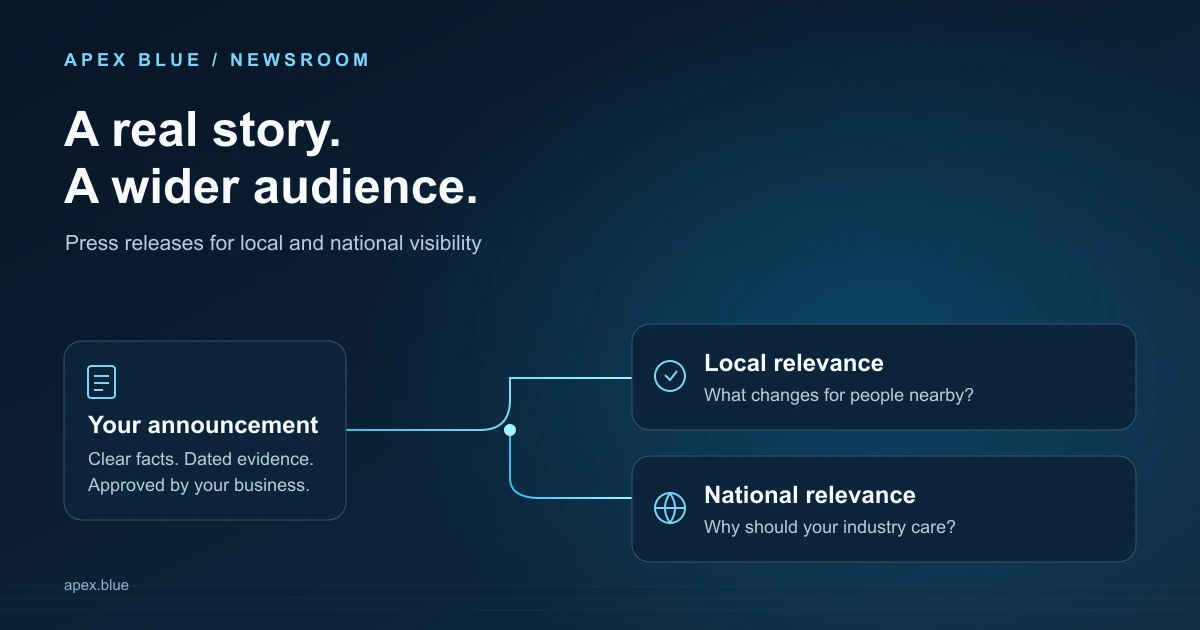
Local news works best when the change matters to people in a specific place. A new office, expanded appointment availability, a public event or a meaningful community project can give nearby customers a reason to look more closely.
Consider a hypothetical service company opening a second staffed location. A helpful announcement would explain the opening date, the services available there, how customers can book and what changes for existing customers. A local reader should understand the development without decoding a sales pitch.
Publish the supporting announcement on your website and connect it to the appropriate location or service page. Check that the address, hours and contact details agree with the rest of your public information. Where appropriate, update your Google Business Profile separately rather than expecting a press release to update it for you.
Google says local results depend mainly on relevance, distance and prominence. Its guidance also emphasizes complete, accurate business information. A release cannot change how far your business is from a searcher or replace the ongoing work of maintaining your profile. Google's local ranking guidance.
The local opportunity is specific: help people understand a real change in their community and give them a useful place to act on it. Listing dozens of nearby cities in an otherwise generic release adds little for the reader. Mention the places genuinely affected by the news and explain why.
How a press release can support national SEO
A national audience needs a reason to care beyond your home market. An industry development, a significant product launch, original research or a documented operational milestone may provide that reason.
For example, a hypothetical manufacturer introducing a new capability could explain which customer problem it addresses, when it becomes available and what evidence supports the stated specifications. If the announcement includes research, readers need the methodology, sample size, collection dates and limitations.
Give the release a focused destination on your website. A product announcement can link to a detailed product page. A study can link to a complete research page. That destination should answer the questions a journalist, buyer or industry reader would reasonably ask next.
National relevance comes from the substance of the announcement. A small company can have a story that matters across an industry. A large company can publish an update that only matters internally. Choose the audience based on the news rather than the size of the distribution list.
Paid distribution and independent coverage measure different things
Press release distribution makes your approved announcement available through a purchased service. Syndicated copies are paid placements, even when they appear on websites with familiar publication names.
Independent editorial coverage involves a separate editorial decision. A journalist may ask questions, add context or decide the story is not a fit. Buying distribution does not purchase that decision.
Both can have a role in a communication plan, but they belong in different report categories. A distribution report tells you where the announcement was placed. An editorial coverage report tells you where someone independently reported on the story. Neither number alone establishes customer demand or revenue.
When comparing services, ask what the quoted placement count represents, which features are included and how actual outcomes will be documented. Outlet availability, indexing and link attributes can vary.
Avoid the backlink trap
Do not buy a press release because someone promises hundreds of ranking links. Google identifies optimized anchor text in distributed press releases as a potential form of link spam. Google's spam policies.
Use a link because it helps the reader reach the relevant information. A business name, announcement title or straightforward description usually provides a clearer path than repeating a phrase such as “best service in every city.”
Google recommends marking paid links with rel="sponsored"; nofollow is also acceptable for that purpose. Publishers control the attributes on their own websites. Ask how links are handled and avoid treating a paid distribution purchase as a purchase of search authority. Google's guidance on qualifying links.
What about AI search visibility?
A clear announcement can make information about your business easier for people to find and understand. That is a sensible foundation for search experiences that use AI too.
Google says its usual SEO practices continue to apply to AI features. A page needs to be indexed and eligible to appear with a snippet, and no special AI markup is required. Eligibility still does not guarantee that a page will be selected. Google's guidance for AI search features.
Keep claims about results precise. AI search distribution describes a distribution capability. AI citations should describe actual references observed in an AI answer, with the answer, date and source recorded. A crawler visit is a different event. None of these establishes that a business has been included in model training or will appear in a future answer.
Build a release around facts people can check
Before drafting, assemble the information that makes the announcement credible:
- The development and its date. What changed, when did it happen and is the news still timely?
- The audience. Who is affected locally or nationally, and what do they need to know?
- The evidence. Which documents, public pages or approved records support the material claims?
- The limits. What is unavailable, not yet confirmed or dependent on another decision?
- The quote approval. Has the attributed person approved the exact statement?
- The next step. Where can the reader find details, contact someone or register interest?
A company's statement about itself remains a company statement unless there is independent evidence. Keep that distinction visible. Suggested quotes need approval from the person being quoted. Awards, partnerships and customer results need permission and documentation before they appear as facts.
This is where AI can save useful time: organizing approved sources, finding missing information, comparing possible angles and preparing a concise first draft. The final announcement still needs judgment and approval.
Make your website ready for the attention
A release works harder when its destination is ready. Give the announcement a stable URL, a clear headline, a visible publication date and an accessible page that works on a phone. Link it from a relevant part of your website so visitors can find it again.
Keep the next step connected to the news. An event announcement should lead to event details. A new service announcement should explain eligibility and availability. A research announcement should provide the underlying findings.
For eligible pages you control, our Search Submissions service can help submit supported URLs through available search submission channels. Submission requests do not guarantee crawling, indexing or rankings. The APEX Newsroom package includes this support for an eligible owned announcement page.
Measure the business result without inflating it
Set a baseline before publication and keep the categories distinct afterward:
| What to measure | What it can tell you |
|---|---|
| Confirmed paid placements | Where the purchased announcement was published |
| Verified independent coverage | Which publications made their own editorial decision to cover the story |
| Search Console impressions and clicks | How the relevant website pages appeared and performed in Google Search |
| Website referrals | Whether recorded visits arrived from identifiable referring pages |
| Observed AI citations | Whether a recorded AI answer actually referenced the announcement or supporting page |
| Qualified inquiries and sales | Whether your own records connect the attention to useful business outcomes |
Look at branded and nonbranded search separately. Use campaign tracking where supported and confirm inquiries in your own records. A rise in search traffic after a release may have several causes; timing alone does not prove attribution.
How often should a business publish a press release?
As often as it has a credible announcement worth sharing. Some businesses have several meaningful developments in a month. Others have a handful in a year.
A calendar helps you prepare for launches and gather evidence early. It should also leave room for “nothing ready yet.” Repeating thin announcements to satisfy a weekly quota can waste money and make the real news harder to notice.
Ongoing news monitoring is useful when it helps identify stronger stories or spot missing information. Distribution should follow the story and your approval, with a separate decision about the right audience and timing.
Turn your next development into a useful announcement
A good press release gives a business a clear account of something worth knowing. Connect it to a useful website page, distribute it responsibly and measure what happens. That creates a more credible foundation for local and national visibility than chasing placement counts alone.
Explore Apex Blue Newsroom to see how story discovery, fact review, approvals and managed press release distribution fit together. If you want to talk through an upcoming announcement first, contact Apex Blue.
Find the story your business is ready to tell
Apex Blue Newsroom helps you discover credible announcements, prepare a source-backed press release and approve the exact story before distribution.
Explore Apex Blue NewsroomShare this AI marketing article
Related articles and podcast resources
Continue learning with related posts and tune into the Navigating AI with Apex Blue podcast.

What Should a Monthly WordPress SEO Report Help You Decide?
Ask for a WordPress SEO report that connects completed work, search visibility, inquiry quality, and the next useful decision.
Read articleBaltimore Service-Area SEO: What Your Website Needs to Prove
Help buyers understand your service coverage with specific local evidence, useful service pages, and a clear inquiry path.
Read articleAI Content Audit Workflow Steps for Service Businesses
An AI content audit workflow for service businesses that want stronger rankings, better AI search visibility, cleaner website agents, and more useful pages before publishing more content.
Read article