
Website AI Agent Installation: Why the Website Lane Wins First
When business owners picture AI agents, many of them jump straight to complicated internal systems.
They imagine deep integrations, phone-routing logic, automation maps, exception rules, and a rollout that quietly becomes its own department.
Sometimes that level of complexity is justified. Most of the time, it is not the best place to start.
Website AI agent installation is usually the better first move because it sits at the intersection of visibility, trust, speed, and conversion. It helps the business where customers actually meet the brand.
If you want the service version of that approach, the main AI agent installation page shows how Apex Blue structures it.
Why the website lane is easier
It solves a real front-end problem
A good website agent can do useful work immediately:
- answer common questions
- guide people to the right service
- reduce dead-end visits
- collect better lead details
- help the human team start with more context
That is why the website version often feels like an extra employee instead of a science project.
It is easier to govern
The website is a bounded environment.
You can define what the agent should know, what it should say, where it should send people next, and when it should hand off to a person. That makes the rollout more controllable than many internal systems.
It is easier to support
When the agent lives on the website, the support surface is cleaner.
You are usually working with:
- service pages
- FAQ content
- knowledge snippets
- lead capture flows
- escalation paths
That is far simpler than trying to automate every internal edge case on day one.
Why it often performs better for SEO and conversion
This is the part many people miss.
An AI agent on a website does not live in isolation. It lives inside the design, the page structure, the speed profile, the trust signals, the service architecture, and the conversion path.
That means the surrounding website can either help the AI layer or quietly weaken it.
When the website is already being handled well:
- the pages are clearer
- the site is faster
- mobile usability is stronger
- trust signals are easier to understand
- internal links make more sense
- the user journey is less chaotic
That combination gives the AI layer a better chance to rank, convert, and actually help.
This is one reason Apex Blue treats AI agent installation as part of a larger operating conversation. Better design and better structure are not separate from the AI outcome. They are part of the AI outcome.
The cost advantage is real
Website AI agent installation is usually more cost-efficient than starting with a heavy internal build.
You are not paying for as much integration work, internal exception handling, or cross-department coordination. You are solving one clear problem in one visible place first.
For many businesses, that is the right order:
- make the website fast, clear, and trust-building
- install one useful website agent
- learn from real usage
- expand into internal helpers later if the business truly needs them
That path tends to create less waste.
This does not mean internal helpers are bad
Internal agents can absolutely be valuable.
Proposal support, summary generation, SOP lookup, intake routing, and follow-up support can all be smart use cases. But those installs usually feel easier after the website lane is already working.
The business learns faster when the first move is visible, bounded, and easy to measure.
Who this is usually right for
Website AI agent installation is a strong fit when:
- you want a practical first move
- you want the offer to feel warm and useful
- you care about trust as much as automation
- you want to avoid getting dragged into a giant technical maze
- you want AI to support the business without taking over the business
If that sounds familiar, the website lane is probably the right place to start.
A simple way to think about it
Many companies do not need AI transformation theater.
They need one useful agent, in one useful place, doing one useful job.
For a lot of businesses, that place is the website.
If you are comparing options right now, AI agent installation cost is a good companion read. And if you want the direct service page, go straight to AI agent installation.
Put the next step to work for your business.
Tell Apex Blue what you want to improve in your marketing, website, or daily operations. We will help you identify a practical starting point.
Discuss your next stepShare this AI marketing article
Related articles and podcast resources
Continue learning with related posts and tune into the Navigating AI with Apex Blue podcast.
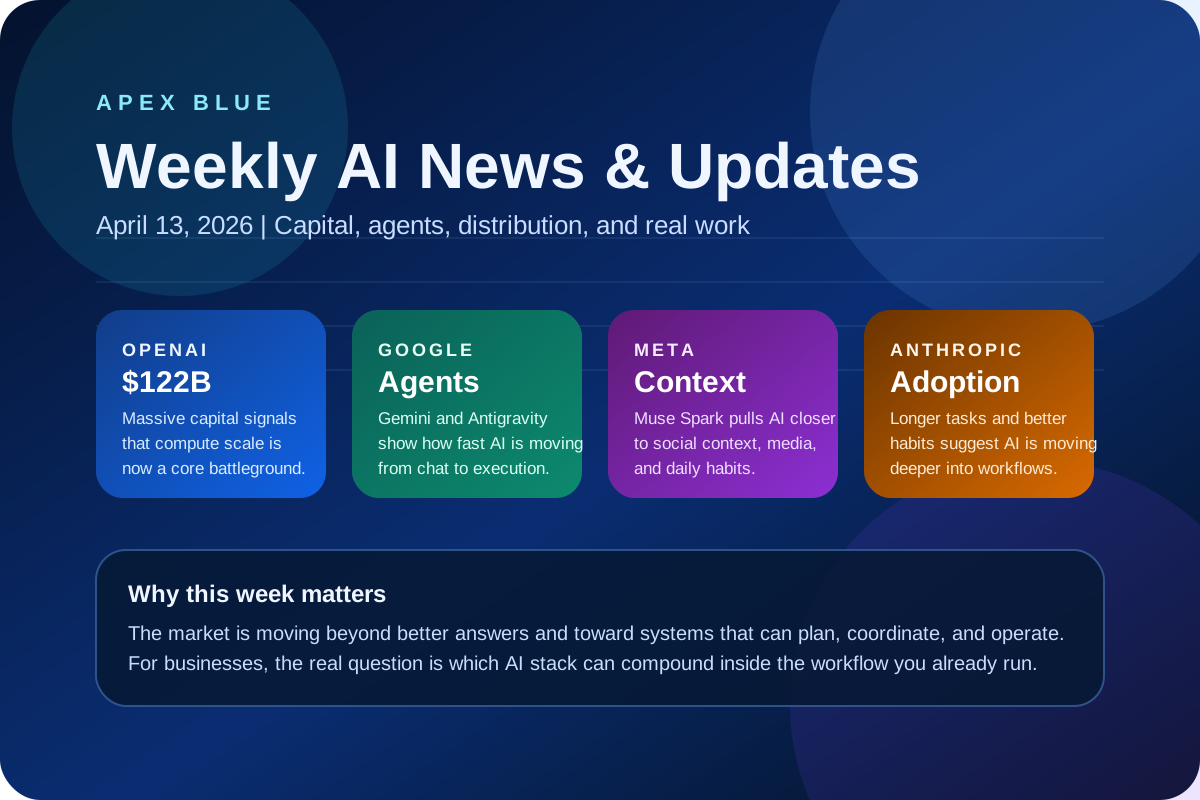
AI News Brief: May 1, 2026 - Agents, Search, Codex, and Enterprise Control
The May 1, 2026 AI news brief: agents are moving into governed business workflows, Codex is expanding beyond coding, Google is pushing AI Mode deeper into browsing, and Microsoft is packaging agent control for the enterprise.
Read article
AI Agent Installation Cost: What Businesses Should Expect Before They Buy
AI agent installation cost depends on scope, workflow complexity, training, support, and whether the rollout is website-first or a deeper white glove build. Here is a practical breakdown for business owners.
Read articleAI Agent Installation vs AI Agent Customization: What Businesses Actually Need
AI agent customization changes behavior. AI agent installation goes further by covering rollout, handoffs, training, support, and the practical business setup needed for the agent to be useful.
Read article